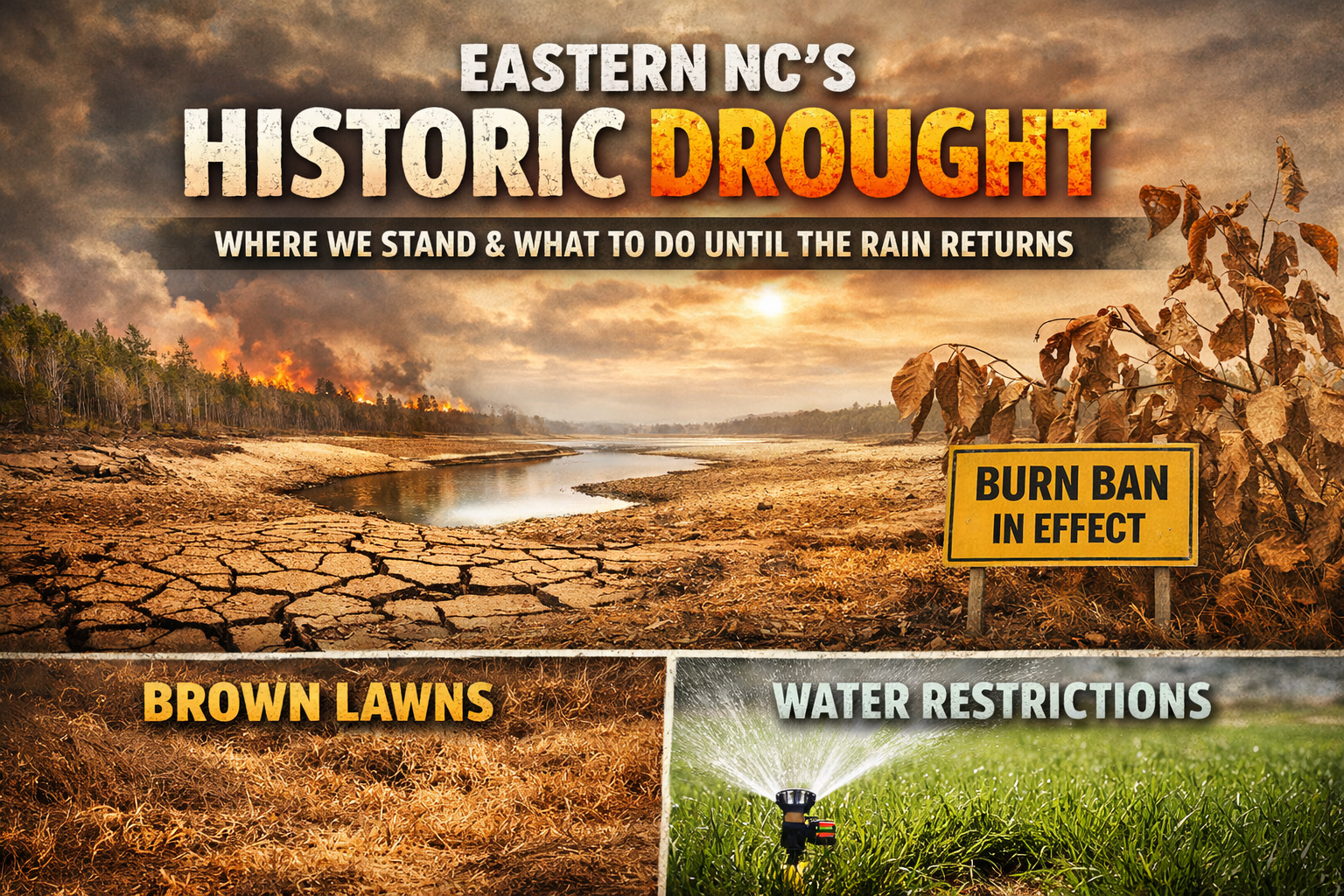

We published Part I three weeks ago, and since then, conditions have gotten measurably worse. Here's a complete breakdown of where we stand, what the data says about what's coming, and what to do with your yard until the rain returns.
When we wrote about eastern NC's drought at the start of April, the situation was already bad.
61% of the state was in severe drought or worse, the burn ban had just gone into effect, and the forecast wasn't promising. What we didn't know was how much worse it would get in the weeks that followed...
This is the updated picture, with supporting numbers.
Where the drought stands right now
As of April 16th, 100% of North Carolina is in some level of drought. That's not a stat that gets revised upward from here; that's the ceiling, we're at the top of the "problem child" list when it comes to a lack of water in our soil.
Thirty counties are now classified as D3, extreme drought, up from 15 counties just two weeks prior on April 2nd; that's a doubling of extreme drought coverage in a 14-day window. Most of the remaining counties are in D2, severe drought, and a small number north of the Albemarle Sound are in D1, moderate drought.
No county in the state has escaped a drought label.
The chair of the NC Drought Management Advisory Council put it plainly this week: "Near record heat, negligible rain, and increased water demand are going to accelerate the decline in river and lake levels over the next few weeks. Reservoir systems are starting to see the impact of increased demand and low inflows." NC Dept. of Environmental Quality
For eastern North Carolina specifically, most of our region is locked in severe drought, as the last measurable rainfall came on Easter Sunday, and the region now has a 5- to 8-inch rainfall deficit for the year alone. WITN
(That's in addition to everything that's accumulated since last August)
How we got here, by the numbers
This drought did not sneak up on anyone; it's been building for eight months, and the data reflects just how extraordinary that accumulation has become.
North Carolina, South Carolina, and Georgia have experienced record dry conditions for the September 2025 to March 2026 period, with records dating back to 1895. (Drought.gov) That's 131 years of data, and the last seven months rank as the driest stretch this state has ever documented.
Across the Southeast, 50 monitoring stations with at least 75 years of data experienced conditions that rank among the top five driest on record for the October 2025 to April 2026 period. Sixteen of those stations set all-time records. Drought.gov
The rainfall station at Raleigh-Durham International Airport recorded the lowest rainfall total year-to-date across a 140-year period. Many streams and rivers are at all-time low levels according to U.S. Geological Survey data. NC Dept. of Environmental Quality
The deficit, going back to last August, stands at over 10 inches for most of eastern NC. Since the start of 2026 alone, most of the region has received rainfall 4 to 8 inches below normal. Drought.gov
This is the largest area of severe drought or worse that the Southeast has experienced since the U.S. Drought Monitor began tracking conditions in 2000. Drought.gov
That puts the current drought in a category of its own.
Why it's getting worse even now
Most droughts have a tipping point where they stabilize; this one hasn't reached that point because the factors driving it are compounding rather than leveling off.
Winter is the season when North Carolina's water supply normally gets replenished.
The DMAC chair noted that this winter, those good rains simply did not happen. The snowfall that did occur had lower-than-normal water content, with snow-to-water equivalents of more than 20 inches of snow to just 1 inch of water. NC Dept. of Environmental Quality, so even precipitation that fell didn't do the work it normally would.
Typically, December through March is when the Southeast recharges its water resources, including soils, streamflows, and groundwater. The persistent dryness has prevented that recharge, so the region is entering its warm season with less stored water than normal. Drought.gov
Now pile near-record heat on top of that...
April temperatures across the region have been well above normal, which means whatever moisture remains in the soil is evaporating faster than it otherwise would. April is shaping up to be a record setter for low precipitation as well. NC Dept. of Environmental Quality
The result is a soil profile that is deeply depleted at every level; surface moisture is gone, mid-level soil moisture is critically low, and groundwater is approaching or at historic lows in much of the state.
There's also a secondary problem that most homeowners don't think about.
When soil dries out enough and for long enough, it becomes hydrophobic, meaning it repels water rather than absorbing it. When rain does arrive, especially in the moderate amounts typical of spring thunderstorms in eastern NC, a significant portion of that water will run off the surface before it has a chance to soak in.
This means, there's no guarantee of improvement when rain finally returns, unless it's a long, steady, and saturating rainfall.
What the outlook says, and what it means for your yard
This is the part most homeowners want to know, and it requires an honest answer.
The National Weather Service Climate Prediction Center's Seasonal Drought Outlook does forecast drought improvement or removal across central and eastern North Carolina through the April to July period. Drought.gov
That's worth noting, as there is a reasonable expectation of some improvement in our region between now and midsummer.
Here's the part that matters for your property decisions right now.
Given the hot, dry conditions in April, along with long-term precipitation, soil moisture, and hydrological deficits, the region needs to return to a more consistent, wetter pattern for drought conditions to truly improve. It needs a longer-term wet period of consistent, soaking rains to help recharge soil moisture, streamflows, and groundwater. This may be difficult, as late spring and summer precipitation in the Southeast typically comes from convective storms, which produce spotty, heavy rainfall that often fails to effectively recharge water resources. Drought.gov
BLUF: Thunderstorms will not fix this.
Eastern NC will get thunderstorms in May and June; these will be localized, intense rain events that drop an inch or two and move on. That kind of precipitation, as welcome as it is in the moment, is not what digs a region out of an 8-month, 10-plus inch deficit.
The soil needs sustained, regular rainfall over weeks, and even if rainfall were to return to near-normal values, drought may linger given the accumulated deficits. Evapotranspiration increases dramatically during spring, meaning water loss accelerates right as growth demand peaks. National Weather Service
The latest Wildland Fire Potential Outlook indicates that wildfire risk will remain higher than normal through the remainder of spring across eastern portions of North and South Carolina. National Weather Service: The statewide burn ban remains in effect until further notice.
The practical translation for property owners is to plan for drought conditions to persist into summer, treat any thunderstorms that arrive as partial relief rather than recovery, and make your decisions accordingly.
What this means for your plants and lawn
Understanding the data is only useful if it changes what you do, so here's how these conditions map directly to your property:
Your soil moisture is critically depleted in the root zone.
This isn't just a surface problem anymore; eight months of drought mean the soil profile your turf and plants depend on has been drawn down at every level. Grass roots that extend 3 to 6 inches have been pulling from a dwindling supply for months. Trees with deeper root systems have fared better, but soil moisture values are low across the region, making planting and germination difficult or impossible without irrigation. Drought.gov
Don't expect your grass to recover on its own right now; it needs help and protection from additional environmental stress.
Trees and shrubs planted in the last three years are your highest-risk assets.
Established trees have root systems that extend well beyond the canopy drip line and access moisture at depths less affected by the drought. Trees planted in the last two to three years have not had time to build that infrastructure, so their roots are still largely in the upper 12"-18" of soil, where moisture has been depleted for months.
If those trees haven't shown signs of stress yet, that doesn't mean they're fine; delayed wilting and canopy dieback can appear weeks after the damage has already occurred underground.
Water these plants slowly, once or twice a week if you can, at the base rather than overhead. You're not trying to save the entire lawn, you're trying to protect the plants that would be the most expensive and time-consuming to replace.
Mulch is currently doing more protective work than anything else on your property.
Fresh mulch at a depth of 2-3" over planting beds and around tree bases is reducing soil temperature and cutting evaporation rates substantially. In normal conditions, mulch is smart; in a drought of this duration, it's damage control. If your beds are bare or your mulch has broken down, replenishing it now is one of the most effective moves you can make before the heat of May and June arrives.
Weeds are filling the gaps your stressed turf is leaving behind.
Drought-stressed lawns have thinned in most properties across eastern NC. Those bare and thinning patches are open real estate, and the weed species that thrive in hot, dry conditions are moving in to claim them.
Early weed control this spring directly protects what recovery your lawn will experience once rainfall does improve. Ignore the bare patches now, and you'll end up managing a full weed infestation while trying to restore the lawn in late summer.
Your mowing height matters more than it normally does.
Cutting grass short during drought stress removes the canopy that's shading the soil and slows evaporation. Raise your mowing height at least one setting above where you normally run it and keep it consistent; don't let the grass get too tall, then cut it aggressively; that shock compounds the stress that's already present.
Watch for secondary pest and disease pressure.
Drought-stressed plants are weakened plants.
Spider mites, aphids, and scale insects all concentrate on stressed ornamentals and turf. Fungal issues can also emerge in stressed plants even without consistent moisture, particularly in areas where irrigation creates wet/dry cycles.
If you're seeing spots, stippling, unusual yellowing, or dieback that doesn't look like simple drought stress, it may be worth a closer inspection before it spreads.
What NOT to do right now
Don't fertilize a stressed lawn.
High-nitrogen applications on drought-stressed turf cause chemical burn and push growth that the plant doesn't have the water to support. Hold off until conditions genuinely improve and consult a professional before applying.
Don't open burn anything.
The statewide burn ban is still in effect. The fuel load across eastern NC is serious, and fire risk is elevated due to dry grass and dead plant material. NC Dept. of Environmental Quality Not worth the risk.
Don't assume one good rain changes the math.
A single storm event, even a decent one, is not enough to reverse 8 months of documented deficit. Given the hydrophobic soil conditions in some areas and the water table's decline in depth, meaningful recovery requires weeks of sustained precipitation. Make your property decisions based on that reality, not on the hope of a single weather event.
Don't leave bare spots unaddressed.
They will not fill in on their own under current conditions; they will become weed corridors that are harder to deal with by midsummer.
In Closing...
Eastern NC has never, in recorded history, come out of a September-to-March stretch as dry as this one.
The deficit is real, the data is clear, and the forecast says recovery is possible, but it won't be fast, and it won't come from a single storm.
Your yard will tell the story of what you did, or didn't do, this spring.
Properties that are mulched, protected, watered strategically, and kept ahead of weed pressure will recover quickly when the rain does return. Properties left unattended during this stretch will require considerably more time, money, and effort to restore once the growing season peaks.
The window to act is right now, before May heat pushes the situation further.
If you want a professional assessment of where your property stands and what it needs, our team works across eastern North Carolina and knows this landscape. Reach out and let's talk.
Landscaping Unlimited, Inc. | Washington, NC | (252) 923-7481