
The green industry looks like one trade from the outside...
A company shows up, works on your property, and makes it look better than it did.
Underneath that "simple" exterior is a regulated industry regulated by at least seven separate bodies in North Carolina, each with its own statute, its own board, its own exam, and its own dollar threshold. Almost no company holds all of them; most companies hold one or two, and they are legitimate, while other companies hold none and are doing work they are not allowed to do.
This post maps the whole thing...
It is written for North Carolina, because licensing is a state function and the rules elsewhere look nothing like ours. If you are in another state, the categories will be familiar, the specifics will not.
Three words that get used like they mean the same thing
Before anything else, we must sort these out, as most of the confusion in this industry lives here:
- A license is legal permission from the state to do a specific kind of work. There is a board, a statute, an exam, and consequences for working without one. If a license is required and you do not have it, the work is illegal.
- A certification is a credential from a private organization proving you know something. It is voluntary, and nobody goes to court over it. It is often a better indicator of actual skill than a license, because licenses test the minimum and certifications test the craft.
- A registration means your name is on a list somewhere. There may be no competency test at all.
A company can be certified up and down and still be unlicensed; a company can be licensed and hold no certifications. Neither one tells you the whole story about whether they are good.
The licenses that carry legal weight
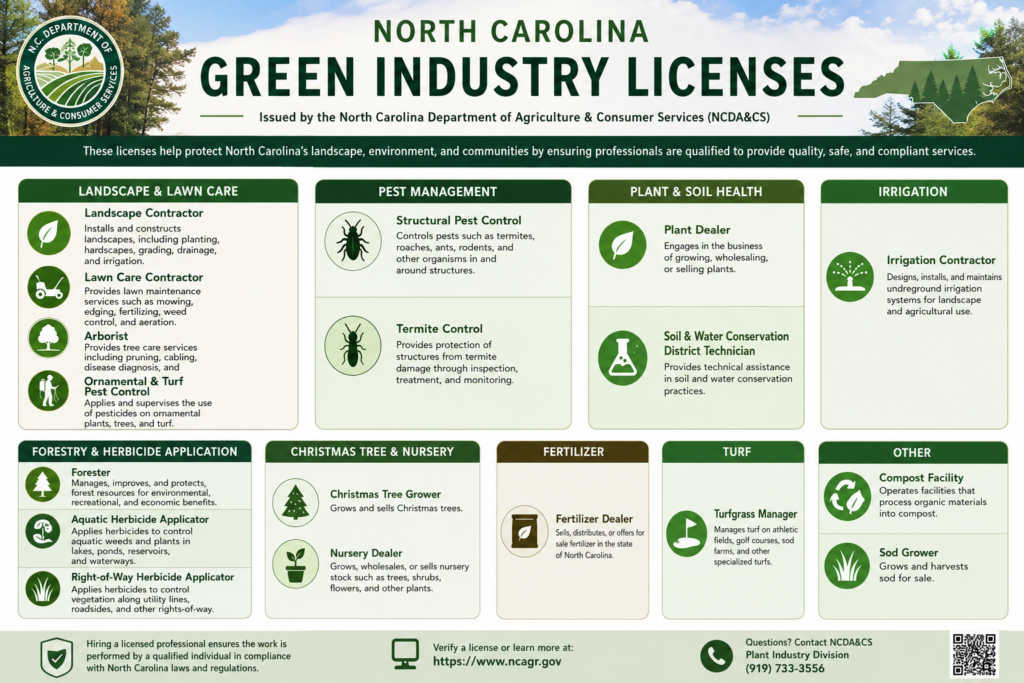
Landscape Contractor
Board: North Carolina Landscape Contractors' Licensing Board Statute: N.C.G.S. Chapter 89D Trigger: $30,000 or more in total contracts for a given job site over any consecutive 12-month period
This is the core license for the trade. It covers installing, planting, repairing, and managing gardens, lawns, shrubs, vines, trees, and other decorative vegetation, including finish grading for what the statute calls decorative utilitarian treatment.
To get one, you need two years of documented landscape contracting experience or a two-year horticulture or landscape degree, and you have to pass an exam. There is a surety bond filed with the board specifically so customers have somewhere to go if a contractor fails to meet their obligations. Renewal is annual, with continuing education required.
There are real exemptions: Property owners working on their own property, golf courses, farm work for agricultural production, and anything under the $30,000 threshold for that site in twelve months.
That threshold is the part that trips people. It is not per contract. It is every contract at that job site over a rolling twelve months, labor and materials together.
General Contractor
Board: North Carolina Licensing Board for General Contractors Statute: N.C.G.S. 87-1 Trigger: $40,000 or more cost of the undertaking
Required for the construction of any building, highway, public utility, grading, improvement, or structure at $40,000 or more. That number was $30,000 until October 1, 2023.
This is where landscape work crosses into building.
A patio is a decorative, utilitarian treatment; a pavilion on footings over that patio is a structure; and an outdoor kitchen with utilities running to it is a structure. A landscape contractor license does not authorize a company to contract for work that falls within the definition of general contracting.
Two things about this license that almost nobody checks:
- It comes in classifications, and holding one does not authorize every trade.
- It also comes in limitation tiers that cap project value: Limited up to $750,000, Intermediate up to $1,500,000, Unlimited with no cap.
A contractor can hold a perfectly valid license and still not be licensed for your project if it exceeds their tier.
LANDSCAPERS MUST BE EDUCATED TO BE SUCCESSFUL:
Irrigation Contractor
Board: North Carolina Irrigation Contractors' Licensing Board Statute: N.C.G.S. Chapter 89G Trigger: $2,500 or more for a given job site
Read that number again; it is not a typo.
Irrigation has its own board, its own exam, and by far the lowest threshold in the industry. A landscape contractor license does not cover it. A general contractor license does not cover it. If you are installing or contracting for irrigation and the job site total hits $2,500, you need this license...
The statute covers piping, fittings, sprinklers, drip tubing, valves, control wiring of 30 volts or less, and associated components. All irrigation work has to be performed under the direct supervision of a licensed individual, and licensees carry ten hours of continuing education every year.
This is the single most commonly overlooked license in the trade. Many companies that install irrigation as a small part of a larger landscape job have never heard of Chapter 89G.
There is one clean exemption worth knowing: An unlicensed company can subcontract to a licensed irrigation contractor, as long as the licensed contractor performs the irrigation work entirely.
Pesticide Applicator
Agency: N.C. Department of Agriculture and Consumer Services, Structural Pest Control and Pesticides Division
Any commercial application of pesticides requires certification. Applicators pass a Core exam plus at least one category exam.
The category that matters for this industry is L, Ornamental and Turf. It covers pesticide use in the maintenance and production of ornamental plants, shade trees, and turf, and it includes commercial work on home lawns, public grounds, parks, shade trees, golf courses, cemeteries, and greenhouses.
Worth noting: ornamental tree work falls under Category L, not the Forest category, even though trees are involved.
Other categories touch this work depending on what you do. H, Right-of-Way for roadside and utility corridor vegetation. A, Aquatic for ponds and water features. D is a separate Pesticide Dealer license required to sell restricted-use products.
Recertification for Category L runs ten credits over five years. Applicators certified in multiple categories complete the requirement for whichever category demands the most, then add three credits per additional category.
Landscape Architect
Board: North Carolina Board of Landscape Architects
This one gets confused with landscape contracting constantly, and they are unrelated.
A landscape architect is a licensed design professional. The path runs through an accredited degree, documented experience, and a national examination. Landscape architects prepare and seal drawings. On many public and commercial projects, a sealed landscape architectural drawing is required before anyone can build anything.
A landscape architect license does not authorize you to contract for the installation. A landscape contractor license does not authorize you to seal a drawing. Some firms hold both, in the same way an architecture firm might have a construction arm, but they are separate credentials doing separate jobs.
Nursery Dealer and Nursery Registration
Agency: NCDA&CS Plant Industry Division, Plant Protection Section
If you sell plants, you need a certificate. This surprises people who think of themselves as installers rather than retailers.
A Nursery Dealer certificate covers companies that do not grow nursery stock but obtain certified stock for resale. If you buy plants wholesale and sell them to a customer as part of a job, that is reselling nursery stock. There are roughly 2,700 nursery dealers distributing plants across the state.
A Nursery Registration certificate covers growers of one acre or less selling only within North Carolina, with certified nursery status for larger operations.
The definition of nursery stock is broader than most people assume. It covers plants, plant parts, trees, shrubs, vines, bulbous plants, roots, grafts, scions, and buds. Turfgrass is specifically included. Annual plants, cut flowers, and true seed are excluded.
Electrical, plumbing, and the trades that touch landscape work
Landscape lighting, water features, outdoor kitchens, and irrigation connections all eventually meet a licensed trade.
Line-voltage electrical work and any connection into a building's electrical system falls under the North Carolina State Board of Examiners of Electrical Contractors. Plumbing connections and backflow prevention on potable water fall under the plumbing board, and most local water authorities separately require a certified backflow assembly tester to test and certify the device on an irrigation connection.
Low-voltage systems are treated differently from line voltage, and the specifics are worth confirming with the relevant board rather than assuming. This is the area where well-meaning companies most often drift into work that belongs to someone else.
Commercial driving and DOT
Not a green industry license, but it gates the work all the same.
Once a truck and trailer combination crosses 26,001 pounds of gross combination weight rating, you are in commercial driver's license territory. Crossing state lines puts you under federal motor carrier rules, with a USDOT number, driver qualification files, medical certificates, and drug and alcohol testing through a consortium.
Plenty of landscape companies are running combinations over that weight without realizing what they have stepped into.
What North Carolina does not license, and it surprises everybody
Tree care.
There is no state license to climb, prune, or remove trees in North Carolina, not one. Anyone with a chainsaw and a truck can legally advertise tree work tomorrow morning.
OSHA standards apply, and the state Department of Labor runs a special emphasis program for logging and arboriculture, which tells you something about the injury rate. But there is no competency licensing.
This is exactly why the ISA Certified Arborist credential matters so much in tree care. It is voluntary, which means it is the only thing separating the professionals from everybody else. In a trade with a license, the license is the floor. In tree care, there is no floor, so the certification is doing all the work.
The certifications worth knowing
None of these are legally required, and all of them signal something a license does not.
ISA Certified Arborist, and Tree Risk Assessment Qualification for anyone evaluating hazard trees. ASCA Registered Consulting Arborist for appraisal and expert witness work.
NALP Landscape Industry Certified, in technician, manager, and horticultural technician tracks.
North Carolina Certified Plant Professional, through the NC Nursery and Landscape Association. Regionally respected and specific to our plant palette.
Irrigation Association credentials: Certified Irrigation Contractor, Certified Irrigation Designer, Certified Landscape Irrigation Auditor.
Concrete Masonry and Hardscapes Association installer credentials for pavers and segmental retaining walls.
ASBA Certified Field Builder and Certified Tennis Court Builder, for athletic surface construction. These are frequently required by name in public bid documents, which effectively makes them mandatory for that work even though they are private credentials.
Sports Field Management Association Certified Sports Field Manager.
OSHA 10 and 30-hour cards, increasingly required to set foot on commercial and institutional sites.
FOLLOW LANDSCAPING UNLIMITED ON FACEBOOK
So why does one company hold one license and another hold five?
Business models
A route-based maintenance company mowing residential properties may never cross a single threshold. A design-build firm building outdoor living spaces crosses three of them on one project.
Growth forces it
Every one of these thresholds is a dollar amount, and material and labor costs keep rising. A company doing $22,000 landscape installs three years ago is doing $34,000 installs today with the same scope. The threshold did not move; the company did.
Licenses attach to people, not companies
This is the part outsiders never understand. In most of these programs, an individual passes the exam and qualifies the business entity. If that person leaves, retires, or dies, the company can lose the license overnight, mid-project. Companies that have been through that once tend to get a second person qualified quickly.
Carrying a license costs real money every year
Renewals, continuing education hours, bonds, financial statements, exam prep. A company that does irrigation twice a year is often better off subcontracting to a licensed irrigation contractor than carrying the license, the CE hours, and the liability for two jobs.
Subcontracting is a legitimate answer
A company holding one license and using licensed subs for everything else is doing it correctly. What matters is that every piece of work is performed by somebody licensed to perform it.
Public and commercial work forces the issue
Government agencies, institutions, and general contractors verify licenses before they award anything. Specialty certifications get written into bid documents by name. In that market, credentials are the entry ticket rather than a differentiator.
Two rules that catch honest people
The threshold counts the site, not the contract: Under the landscape contractor statute, it is every contract for that job site over twelve consecutive months. Splitting one project into two smaller contracts to stay under a threshold is a violation, not a workaround.
You can violate a licensing law without ever picking up a tool: The Landscape Contractors' Licensing Board has pursued a case where an individual bid hardscape jobs over the threshold and subcontracted the work out. He performed none of the labor, yet he was still in violation for quoting the work, and the unlicensed subcontractor was in violation for performing it.
There is also a financial consequence most contractors have never considered. In North Carolina, contracts entered into by unlicensed contractors have been held unenforceable. A customer may have a legitimate argument that they do not have to pay for work performed without the required license.
How to check anybody in five minutes
Every board named in this post maintains a free public license search.
Three things to verify. The exact legal entity on the contract has to be the entity holding the license, not a similar name or a related company. The classification or category has to cover the actual work. The limitation or scope has to cover your project size.
Ask for license numbers in writing. Nobody legitimate hesitates.
Licensing law changes, thresholds get adjusted, and specific projects raise specific questions. This post is a map, not legal advice. For authoritative answers, contact the relevant board directly. We are contractors, not attorneys.