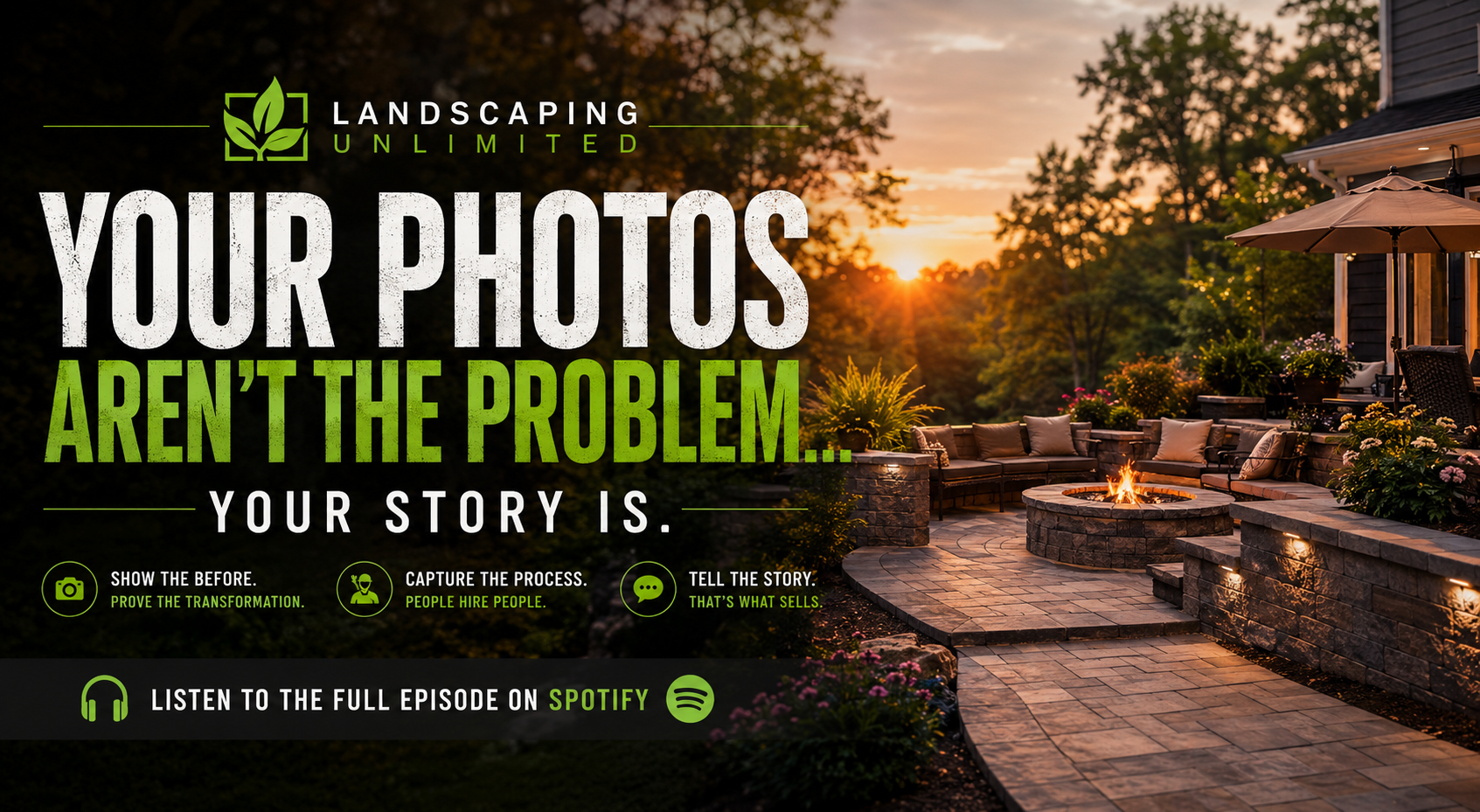

You did the work; three days of it...
Base cut and packed, pavers set by hand, edges cleaned up, jobsite blown off before you pulled out, and then you took the picture, posted it, and got fourteen likes and nothing else...
- No calls.
- No messages.
- Nothing that turned into a quote.
That happens to good crews constantly, and almost every one of them draws the wrong conclusion from it. They decide social media does not work for landscaping, or that they need a better camera, or that the algorithm buried them...
Usually none of that is the issue; the issue is that the photo is being asked to do a job photos cannot do by themselves. Here is what is actually going wrong.
Your photo answers the wrong question
A photograph answers exactly one question, "What does it look like?"
That is not worthless; it is just not enough to make somebody spend eighteen thousand dollars...
A stranger scrolling past your finished patio learns that you are capable of building a patio, and then they keep scrolling, because so is every other hardscape company in the county and all of their pages look the same as yours.
The questions that actually move a homeowner are different.
Why was this built? Who is it for? What was wrong here before?
Nobody in the history of this trade has ever bought "hardscape".
What they've bought is the Saturday afternoon they are going to have on it; the graduation party, the fire pit in October, the place where the grandkids play where the mud used to be, the bragging to friends, and the memories...
If your post never says any of that out loud, you have handed the customer the job of imagining it for themselves, and most of them will not take the assignment.
LISTEN TO THE FULL EPISODE ON PHOTOGRAPHY ON SPOTIFY
Proof of work stopped being an advantage
There was a stretch, not that long ago, when posting finished jobs put you ahead; half the guys in the trade posted nothing at all, so anything beat zero, and showing up with proof was the differentiator.
That window closed.
The National Association of Realtors found that 89% of buyers rated photos as useful during their home search, and that just over half of buyers now find the home they eventually purchase online. Read that like an owner instead of a marketer; photos are not a competitive edge anymore; photos are the price of admission.
Everybody has them, so the photograph is no longer the thing that separates you; it is the thing people scroll past on the way to somebody who gave them a reason to stop.
Proof is the floor, not the ceiling, and if proof you exist is all you are posting, you are competing on nothing.
FOLLOW LANDSCAPING UNLIMITED ON INSTAGRAM
There is no before, so nobody knows what you accomplished
Most crews either skip the before or shoot it out the truck window on the way in. It is the cheapest fix available to you and the most expensive thing to keep ignoring.
Without a before, your after has no weight.
A retaining wall leaning quietly out of plumb, a slope washing into the driveway every time it rains, twenty years of log trucks on a residential drive. None of that exists to the person looking at your feed unless you showed it to them.
Get out of the truck, shoot the before from the same position and roughly the same focal length you plan to use for the after, so the two frames line up when somebody swipes between them.
Shoot wide enough that the problem is obvious to a person who has never stood in that yard, and shoot it before the crew stages, because a before photo with a skid steer already parked in it is not a before photo.
It is a job in progress, and it costs you the exact contrast that would have made the post land.
You skipped the middle, so there is no human being in it
The finished product proves you can do the work; the middle tells the story of what is happening, and proves you deserve what you charged for it.
Nobody outside this trade understands what goes into a hardscape install.
They see the patio, they see the invoice, and they never connect the two. That gap is where your price objection comes from; so close it.
Show the string line, the packer, hands laying pavers in July with a shirt that has gone through three colors of wet. Day one, when the base is being cut and packed, and there is nothing pretty in the frame...
A delivery truck backing down a driveway that was never built to hold it.
These kinds of photos put people in the story, and people hire people; they don't hire patios.
This is also exactly where most guys quit taking photos, because the middle is ugly and they are tired and covered in dust. Which is why the crews that keep recording stand out.
Timing Matters
None of the above excuses weak photography; the craft requires effort and practice, and oft forgotten is timing...
Most jobsite photos I see are taken at the single worst time of day available; harsh light noon.
A patio shot at two in the afternoon looks like a parking lot. Flat light, dead color, and every texture you spent three days building disappears into a white or light gray.
Come back to your job at golden hour, or come back earlier in the day. Give the concrete some shape; wet the pavers down if the color has gone chalky. Get low, because low shots make hardscape look like true architecture instead of just a floor.
Shoot detail too:
The cut edge, joint line, cap on the wall...
Detail is proof of craftsmanship in a way a wide shot never manages, because a wide shot flattens everything into a generic idea of a patio instead of this specific patio, built by these specific hands. Decide before you shoot whether it is going vertical for social media (TikTok or Instagram) or horizontal for Facebook and the website.
Figuring that out afterward is how good work ends up cropped into nothing.
Your caption did no work at all
"Another one in the books" with three fire emojis is not a caption...
It is a placeholder for something that should share more of what's actually going on in the image.
The fix takes one answer to ay of these questions asked before you pull off the job:
- "What is the first thing you are going to do out here?"
- "Why are we here in the first place?"
- "What did we fix?"
- "Why were we the ones called?"
Nine times out of ten, the homeowner hands you an answer better than anything you would write sitting in the truck at the end of a long day. Somebody tells you their daughter's rehearsal dinner is happening out there in September, their dad is driving down from Virginia in the fall, and this is the first place he is going to sit; they just want to drink coffee in the morning without standing in mud, etc.
When you ask how the space is going to be used, you usually get all the answers you need to why you're there and what the purpose of your work is...
The same thing is happening in real estate
If you shoot listings, this applies to you identically.
A listing photo sells square footage; a story sells the house.
The agent posting twenty-two clean interior frames is doing the job as assigned.
The agent who mentions that the back deck holds sun until seven in the evening in June, that the Fourth of July parade ends at the top of this street, that the previous owners raised three kids here and finally sold when the last one moved to Raleigh, is selling something no competitor can copy by hiring a better photographer.
Buyers are looking at the same twenty-two frames on every listing in the county. The house with a story attached is the one they are still talking about at dinner.
What this comes down to
The work is real, the heat is real, the equipment payment is real, the three days of base prep nobody ever sees is real. When you reduce all of it to one flat photo and a lazy caption, you are the one deciding it is worth less than it actually is.
Show the mud, the hands, the wall that will outlive you...
Ask the customer what this place is going to mean to them, then say it out loud in your own words when you drop the photos. Remember, your pictures get somebody to look, your stories get somebody to call.
The Landscaping Podcast is hosted by Shay Brickhouse and Zac Small of Landscaping Unlimited, Inc., serving Eastern North Carolina from Washington and Bath.