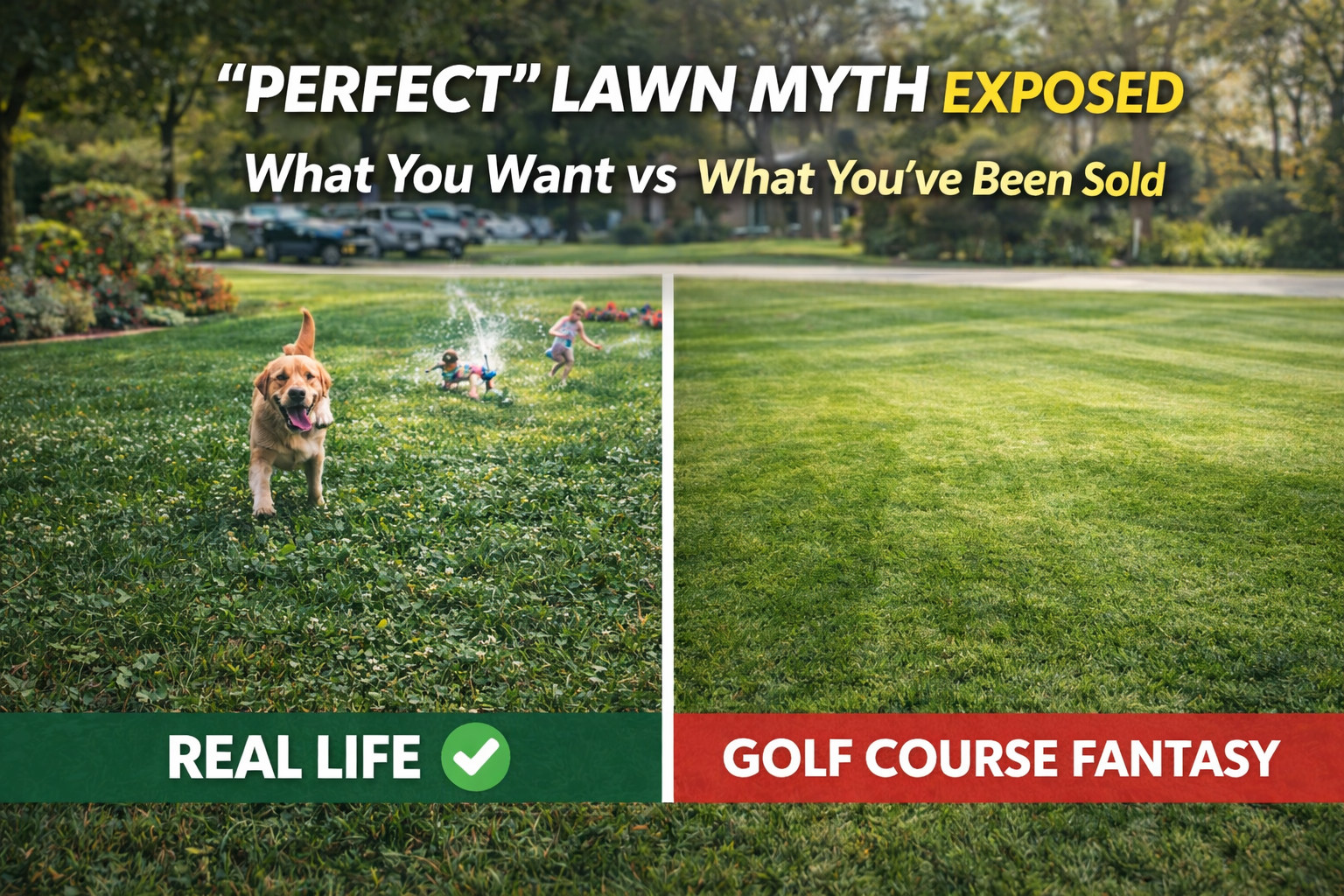

Get what you actually want, not what you’ve been sold
What does a “perfect” lawn look like?
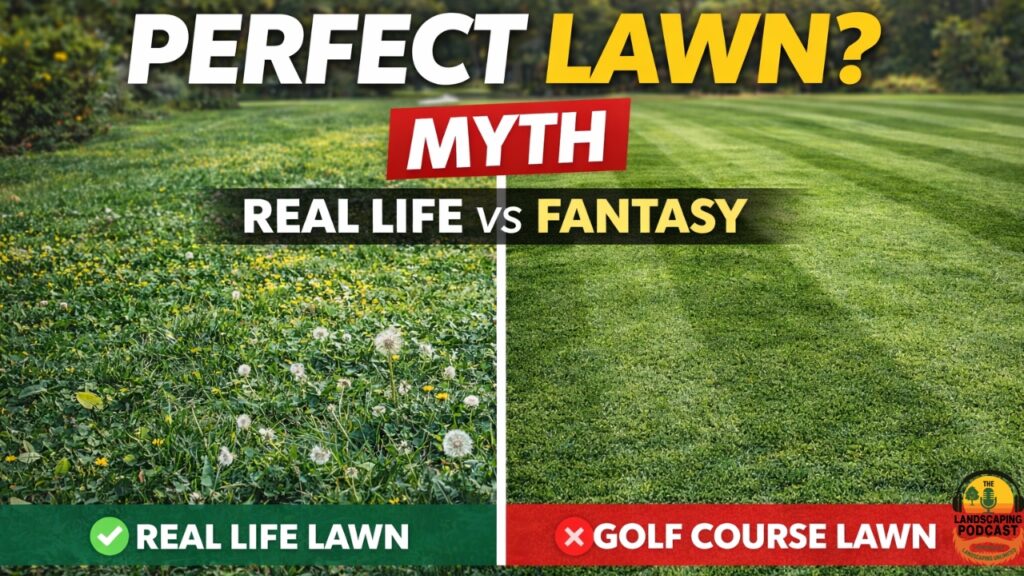
Most homeowners answer that question with an image they didn’t create.
Somewhere between HOA pressure, marketing, and the golf-course fantasy, “perfect” became a single standard of flawless green, uniform texture, zero weeds, and stripes on command. The problem is that the standard shared is designed for appearances, not for real-world use.
When you chase a lawn you’ve been conditioned to want, you end up paying for it in ways nobody mentions. Money disappears into treatments and quick fixes, time disappears into maintenance you didn’t sign up for, and if you’re trying to keep things “sterile,” chemicals often become part of the routine, whether you want that or not.
Shay and Zac discuss this in Ep. 33 of The Landscaping Podcast because they kept seeing the same pattern of homeowners who don’t need more lawn products; they need a clearer definition of what they want.
They would meet the owner only to find that the yard wasn’t “failing”; it was being measured against a standard that may not align with the homeowner’s goals, budget, or lifestyle.
A lawn can be healthy without being “perfect”
A lawn can be better for kids, pets, soil, and your wallet without looking like a magazine cover.
In a lot of cases, a slightly more natural lawn isn’t just easier, it’s actually the smarter, better-looking choice in real life because it fits the way people live on their property.
The biggest win is choosing your lawn standard intentionally rather than inheriting it. Ask yourself what you’re optimizing for:
- Do you want low maintenance and lower inputs?
- Do you want curb appeal above everything else?
- Do you want a yard you can use without obsessing?
Those are distinct targets, with different expectations and plans.
This is why the “perfect lawn” conversation matters; perfection is expensive.
The more you demand visual perfection, the more you commit to ongoing maintenance. That’s not a judgment; some people genuinely want that, but most homeowners don’t want to live in a weekly cycle of chasing the next correction; they want a yard that thrives without turning into a never-ending project.
If you’re trying to move toward a healthier, less stressful lawn, the path usually isn’t complicated; it’s just not glamorous.
You start thinking long-term, focusing on the fundamentals that make grass resilient rather than cosmetic fixes that increase your workload. Then, you stop reacting to every imperfection like it’s a crisis and start building a yard that holds up across seasons.
The most common “perfect lawn” trap is psychological.
People look at their grass and feel like they’re failing because it doesn’t look like a golf course. That mindset turns the yard into a scoreboard, and every weed becomes personal. But if your goal is a lawn that works in real life, you’re allowed to choose “healthy and functional” over “flawless and fragile.”
That’s the heart of this episode: Get what you want, not what you’ve been sold.
Define your lawn standard based on your goals, budget, and lifestyle, then prioritize the inputs that support it.
If you want to watch the full discussion, catch Episode 33 on YouTube here: “Lawn Perfect: Get What You Want, Not What Your Sold”